
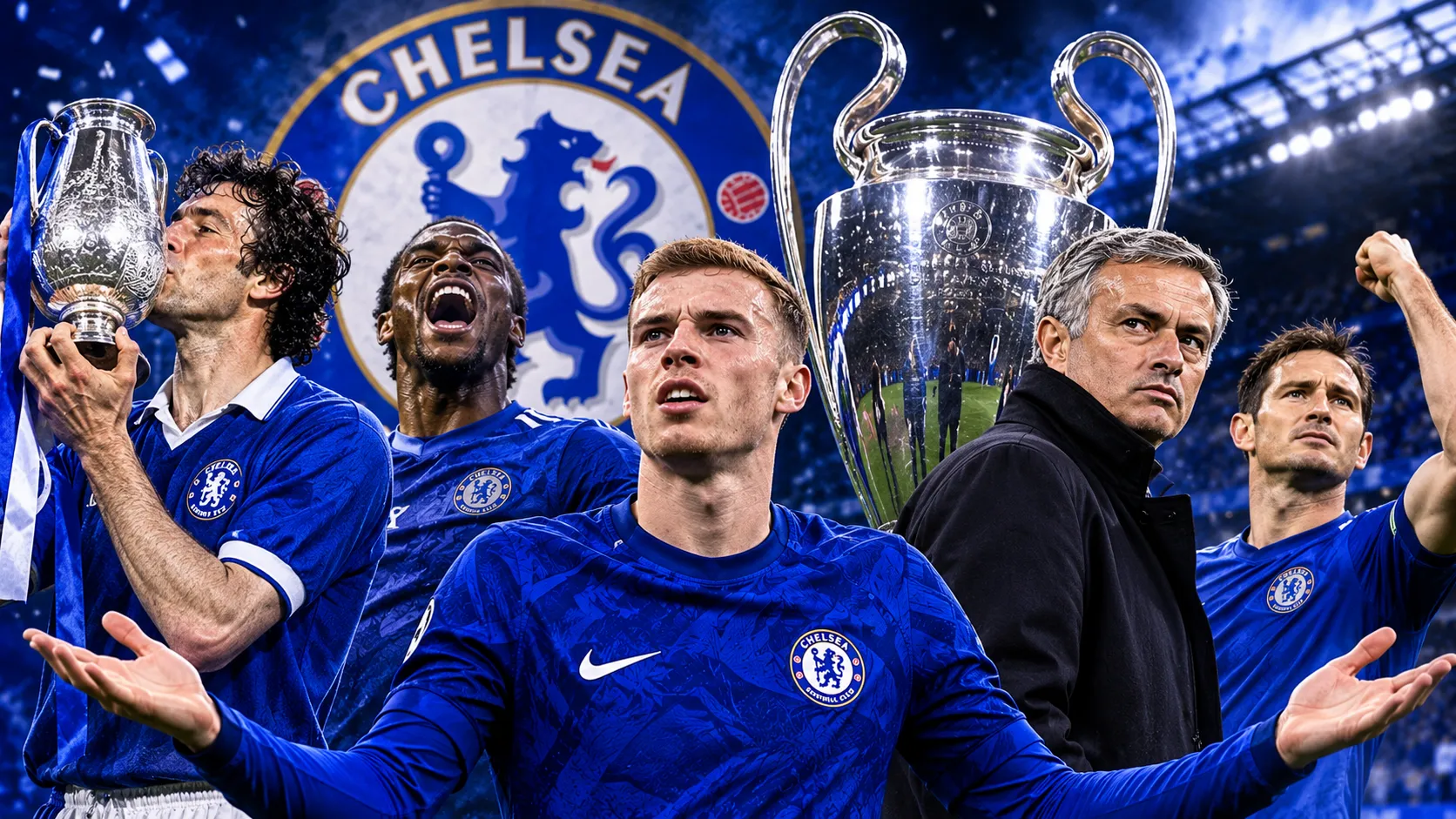
Chelsea’s European record reads, on paper, like that of a continental heavyweight: two Champions League titles, two Europa Leagues, two Cup Winners’ Cups. Look at how those trophies were won and it becomes one of the odder collections in the game, because the club has a habit of winning in Europe in seasons when it was plainly not among the best teams on the continent.
That is not a criticism. It is a genuinely interesting pattern, and it says something about what knockout football actually rewards.
How did the 2012 win actually happen?
Chelsea won the Champions League in 2012 having finished sixth in the Premier League. Sixth. They sacked their manager in March, appointed a caretaker from the coaching staff, and then beat Bayern Munich on penalties in Bayern’s own stadium.
The route there was more improbable than the final. A semi-final against Barcelona the best side in the world at the time was survived with ten men for most of the second leg, and the goal that settled it was scored in stoppage time by a striker who had spent eighteen months looking like the worst signing in the club’s history.
No club had previously won the competition from that low a domestic finish. It also made Chelsea the first London club to win Europe’s top trophy, which is the sort of fact that gets lost when the rest of the story is that strange.
The 2021 version, which was different
The second title was won properly, and the contrast is instructive. The 2021 side was rebuilt mid-season by a new manager who arrived in January, reorganised the defence into a back three, and produced one of the best defensive records in the competition’s history over the second half of the campaign.
That team beat Real Madrid over two legs and then Manchester City in the final the best side in England that year, and the side everybody expected to win. It was a tactical victory rather than a lucky one, and it has aged better in the memory than 2012 has.
The two together make the pattern. One title won on resilience and chance, one won on structure, neither won by a team that led its own league.
Why does knockout football reward this?
Because a two-legged tie is a small sample, and a small sample rewards the things Chelsea have repeatedly been good at: defending a lead, surviving a bad spell without conceding, and taking one chance in a game where there were only two.
League football over thirty-eight matches rewards consistency, squad depth and the ability to beat mid-table sides every week. Knockout football rewards none of those reliably. A side that is excellent at defending for ninety minutes and dangerous from one set piece can beat a better team twice in a fortnight, and that is not an upset so much as the format working as designed.
Chelsea have been built that way more often than not organised, hard to break down, dangerous on transition which is a profile that underperforms over a season and overperforms in a cup. Our piece on what made Chelsea’s great defences work covers the mechanics of that.
The near misses, which are the better stories
The 2008 final in Moscow, lost to Manchester United on penalties, after the captain slipped taking the kick that would have won it. That is still the single most painful night in the club’s history and it happened to the strongest Chelsea side of the period, which is exactly the inversion this article is about.
The 2009 semi-final against Barcelona, settled by a stoppage-time goal after a series of penalty appeals that were argued about for years. The 2004 semi-final against Monaco, thrown away from a winning position. Through the mid-2000s Chelsea were consistently among the two or three best teams in Europe and did not win it once.
The trophies arrived later, with worse teams. If you wanted a single example of why league tables and European honours measure different things, this club provides it.
The Super Cups attached to those wins are worth a footnote. Chelsea have won the European Super Cup more than once, each time as a consequence of a trophy already in the cabinet, and those matches tend to be forgotten entirely a one-off fixture in August that counts in the honours list and in almost nobody’s memory of the season.
The Cup Winners’ Cups, which came first
Both of them are worth remembering because they predate the money entirely. The 1971 win involved beating Real Madrid in a replayed final in Athens, which for a club that had won its first league title only a few years earlier was a substantial achievement.
The 1998 win came in a period when Chelsea were an improving cup side rather than a league force fourth or sixth in the table, collecting knockout trophies which is the same profile as 2012 in miniature.
That competition no longer exists, having been absorbed into the UEFA Cup, which makes those two trophies a closed set. It also means Chelsea have won every UEFA club competition that was available to them during the periods they qualified for them, which is a genuinely unusual line on a club’s record.
How does it compare to other English clubs?
Favourably on trophies and oddly on method. Only a handful of English clubs have won the European Cup or Champions League at all, and Chelsea are among the few to have won every UEFA club competition available to them in the periods they qualified.
Where the comparison gets interesting is consistency. The English clubs with the deepest European histories built them across sustained periods of domestic dominance they were the best team in England and then went and proved it in Europe. Chelsea’s trophies arrived in seasons when the club was second, fourth or sixth at home.
That makes the record harder to interpret than a straight count suggests. By one measure Chelsea are one of England’s most successful European clubs; by another they have never been Europe’s best team in any season, including the two they won it. Both statements are true, and which one you lead with says more about the argument you are having than about the club.
What it tells you about the club
That Chelsea have, for most of the last twenty-five years, been a very good cup team and an inconsistent league one. The trophies came in bunches around particular managers and particular defensive structures, and the gaps came when the side was built to play more expansively.
It also tells you something about how the club was run. A squad that changes manager frequently but keeps its senior players develops a kind of institutional knowledge about knockout football how to defend a first leg, when to accept a draw that survives the person in charge. That is not an accident and we look at it in why Chelsea change managers so often.
Frequently asked questions
Where did Chelsea finish the season they first won the Champions League?
Sixth in the Premier League. They also sacked their manager in March and won the competition under a caretaker, which no club had previously managed from that position.
How many European trophies have Chelsea won?
Two Champions Leagues, two Europa Leagues and two Cup Winners’ Cups, plus European Super Cups attached to some of those wins.
Why do Chelsea do better in Europe than in the league?
A two-legged tie is a small sample that rewards defensive organisation and taking single chances. A thirty-eight-game league rewards consistency and depth. Chelsea have more often been built for the first.
What was Chelsea’s worst European defeat?
The 2008 final in Moscow, lost on penalties to Manchester United, by what was probably the strongest Chelsea side of that era.






2 responses