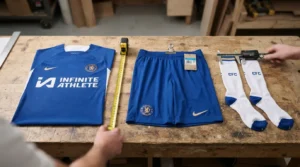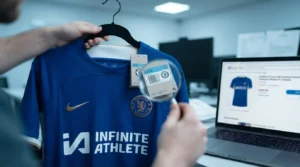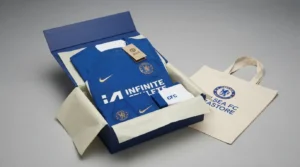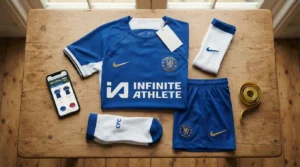
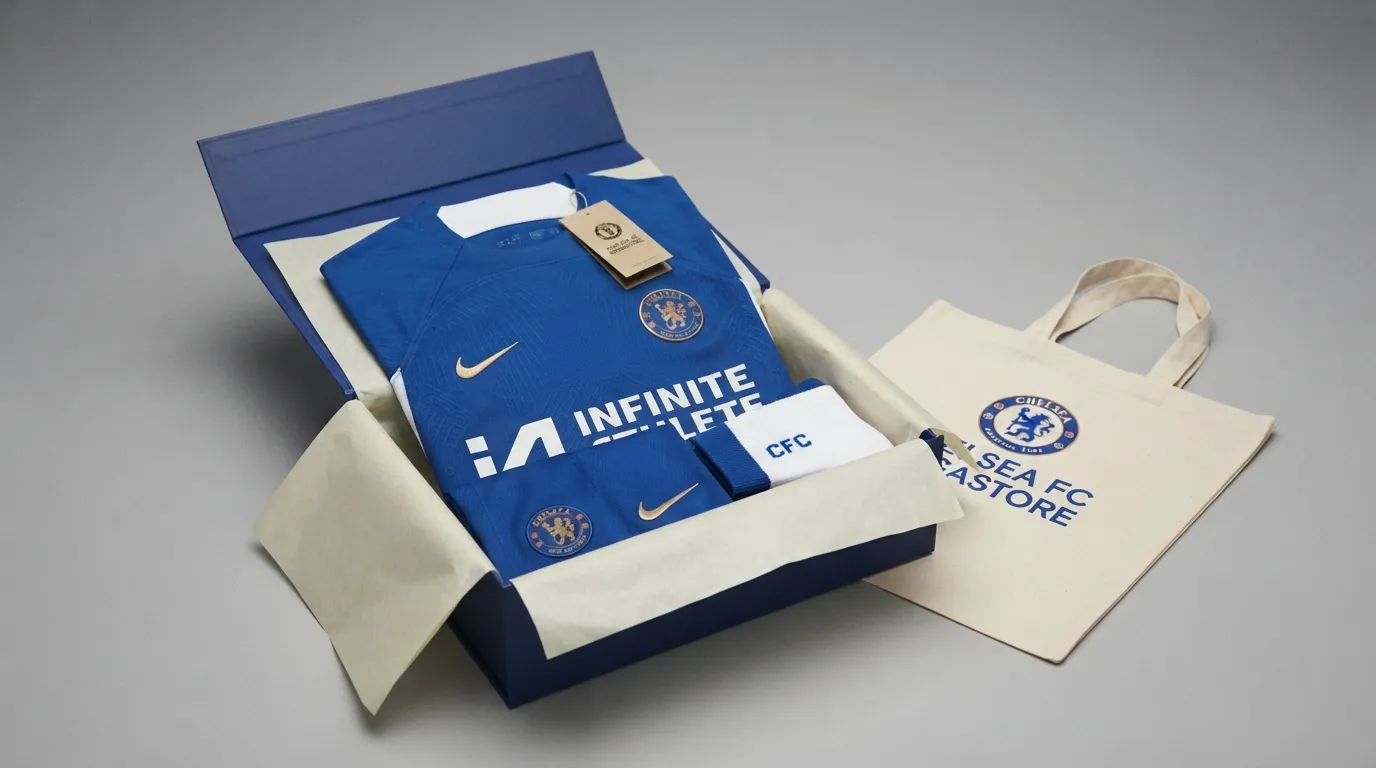
A household that buys the blue for one child and another club’s colours for the next learns that the kit is three pieces on three calendars, whatever the badge. cheap football kits are assembled rather than boxed: the shirt bought when it reduces, the shorts and socks in October when every retailer clears the over-order, the goalkeeper’s padded kit at mid-season, the pieces picked up singly from broken boxed sets, and a Chelsea household that has done it for the blue does it the same way for the rival’s kit in the next bedroom, from the same specialists, on the same dates. The box at launch is the one way to pay the year’s top price for all three.
Here is the kit as a Chelsea household assembles it.
The box and why it is the wrong price
The boxed kit, shirt, shorts and socks in a children’s size, is the sum of three recommended prices, held until the next launch, and bought by parents on Saturdays whose child needs it today. The three pieces reduce separately within months: shorts and socks in October, the change shirt in late autumn, the home after Christmas. A household that has bought the blue box once and the blue pieces every year since knows the difference is most of the price.
The box is right for a child who needs it fitted, exchanged and printed this Saturday. It is wrong for a household that can wait for October and January, and most can.
Why do shorts and socks reduce in October?
Because every retailer orders more of them than of shirts, and by October the surplus shows. Boxed sets break when one size sells out, leaving shorts and socks with no box to belong to; the specialists relist them singly below the boxed share and clear the over-order at the same time. A Chelsea household buys the blue shorts and socks then, white in some seasons, blue in others, and the rival’s shorts and socks in the same order, from the same specialist, at the same reduction.
Blue shorts hide a Saturday morning and white ones do not; a household with a child who plays buys dark shorts for everything but the match.
The shirt at its reduction
The change shirt in late autumn, the home after Christmas, printed stock after a window, and for Chelsea, more printed stock than any club, which the household has relied on for years, last season’s at the launch. The same calendar for the rival’s shirt, which the household buys at the same specialist the same week. What a Chelsea fan already knows about the shirt’s calendar is in cheap football shirts: what a Chelsea fan already knows.
The goalkeeper’s kit: the household’s bargain
A child who plays in goal needs the padded long-sleeve shirt and padded shorts, and a household that has bought the blue goalkeeper kit at mid-season knows it is the cheapest genuine current kit the club sells, produced in small numbers, unsold at the recommended price, reduced within months. The same is true of every club’s goalkeeper kit, and a household with a keeper in another club’s colours buys it the same way.
Children’s sizes, by the height
A genuine children’s shirt states an age band and a height in centimetres beside it, and the height is the number, bands are approximate and differ between suppliers. A child who plays wears the shirt to fit; a child who wears it to the ground can take a band up. A Chelsea household that has sized the blue by height for years sizes the rival’s shirt the same way, and knows that the band that fits in one supplier’s chart is not the band that fits in another’s. How the club brings children through its own system, and what it asks of them, is in inside Cobham: how the Chelsea academy works.
The rival’s kit in the next bedroom
Bought from the same specialist, on the same calendar, with the same checks, the seller’s own photographs, the label with a composition and a children’s product code, a named season, and the colour’s own care routine. A white kit washed as whites; a red one cold with the darks; a sky-blue one alone the first few times. The household’s blue has taught the method; the rival’s colour only changes the wash.
Where a cheap kit is a copy
A current-season boxed kit at a fraction of retail in September, in every size, with a render and no label photograph, is a copy, and a Chelsea household that has seen a copied blue step at the shoulder knows what that fabric does on a child after a month of washing. Genuine clearance names the season, shows the shirt, is in a few sizes, and comes from a seller with a UK address.
The kit, assembled
Last season’s shirt at the launch, or the change shirt in late autumn, or printed stock after the window. Shorts and socks in October. The goalkeeper’s kit at mid-season for the child in goal. Each piece from a specialist, each label photographed, each sized by height. The same list for the rival’s kit, bought the same week. The jersey as a single garment, and what the word means on a listing a Chelsea fan meets, is in cheap football jerseys: the listing word a Chelsea fan should read twice.
How does the household tell a genuine cheap set from a copy?
By the shorts and the label, before the price. A Chelsea household that has bought several blue sets turns the shorts inside out first, because the shorts are where a copied set gives itself away: a genuine pair has a woven inside-waistband label with its own product code, a flat drawstring with finished ends and a lion as detailed as the shirt’s, and a copy has a printed or absent label, a round cord and a blurred crest. A set whose shirt passes and whose shorts fail has been padded, a genuine clearance shirt boxed with copied shorts to reach a set price, and the household has seen it.
Then the shirt’s label, which every genuine shirt from any club carries in the same format: composition, country of manufacture, a product code in the supplier’s structure, several languages. Then the dye, a sleeve across the body in daylight, the blue matched across panels, or the rival’s red or white matched the same way. Then the price against the calendar: a reason, a date, a named season. A set that passes all four is the club’s own kit at a specialist’s reduction; one that fails any is not, however alike it looks in the box. The household runs the same four on the rival’s set in the next bedroom, and the only thing that changes is the colour in the photograph.
Frequently asked questions
When is each piece of a kit cheap?
Shorts and socks in October, the change shirt in late autumn, the home after Christmas, printed stock after windows, goalkeeper kit by mid-season, everything at the next launch.
Is the boxed kit ever right?
For a child who needs it fitted, exchanged and printed today. Otherwise assemble the pieces.
Does the method work for a rival’s kit?
Identically, same specialists, same dates, same checks. Only the colour’s wash routine changes.
How should a child’s kit be sized?
By the height on the label, to fit for a child who plays, a band up for one who wears it to the ground.