helsea in the 1970s is the most instructive decade in the club’s history, because it contains both the best football the club had played and the financial decision that undid it. The two are roughly five years apart.
It is also a decade that explains a great deal about why the club’s relationship with its own stadium has been complicated ever since.
The cup side
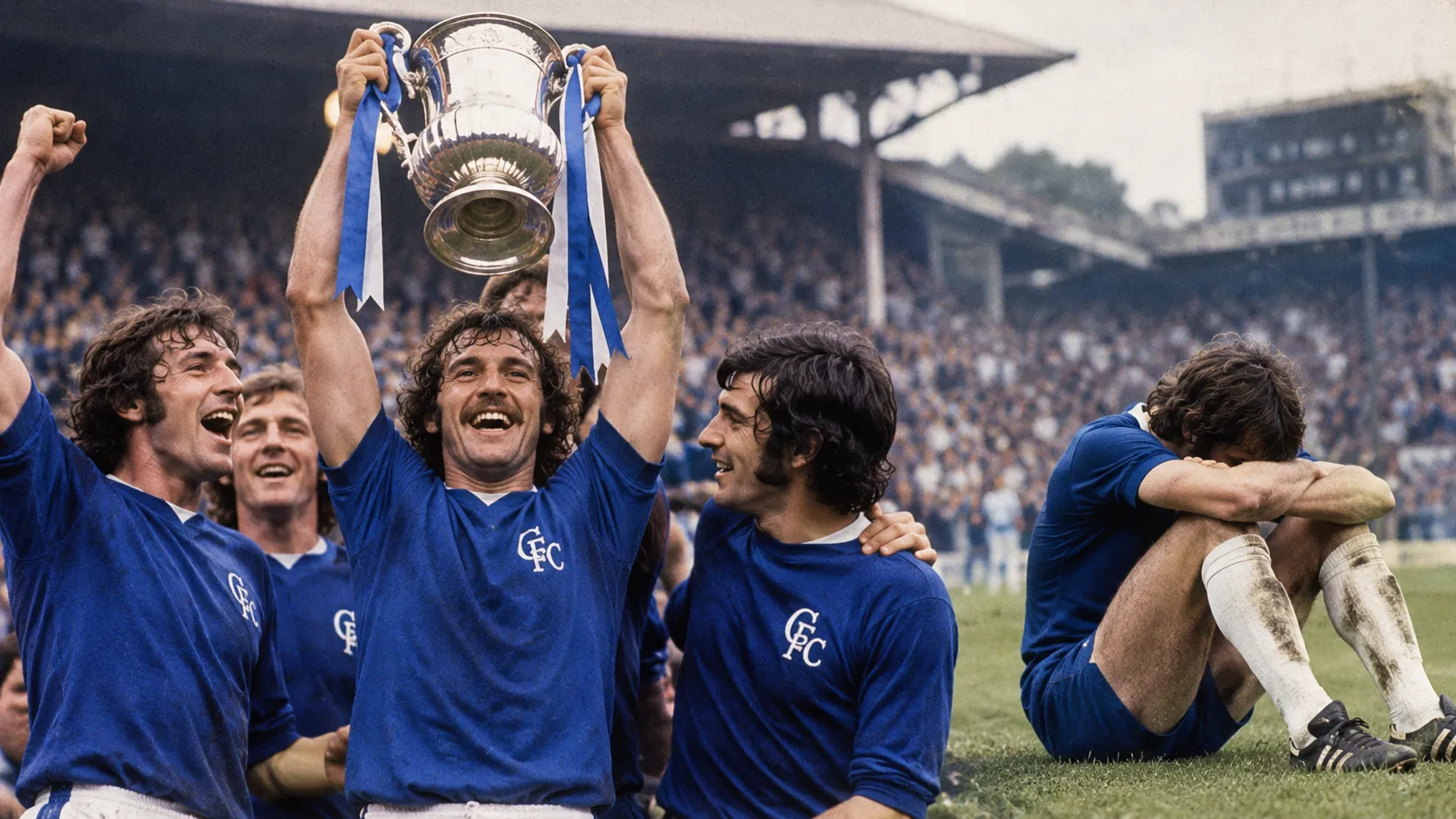
The team that won the FA Cup in 1970 was the most talented Chelsea had assembled. Peter Osgood, Alan Hudson, Charlie Cooke and Peter Bonetti in goal, playing a brand of football that drew enormous crowds and attracted an attention the club had not previously had.
The final itself is remembered as one of the most physical ever played. Chelsea drew 2-2 with Leeds at Wembley and won the replay 2-1 at Old Trafford, with David Webb scoring the winner. Osgood scored in every round of the competition, which is a record shared by very few.
The following season they won the European Cup Winners’ Cup, beating Real Madrid 2-1 in a replay in Athens after drawing the first match. Two trophies in two seasons, with a young side, in front of the biggest crowds in the club’s history.
How big were the crowds?
Large enough to explain the decision that followed, which is the part that gets lost when the East Stand is described as straightforward overreach.
Stamford Bridge was drawing some of the biggest attendances in the country for the cup matches of that period, in a ground whose terracing could hold far more people than its current capacity suggests. The 1970 side was an attraction in a way Chelsea had not been before, and the demand was real.
What the club got wrong was the assumption that it would persist. Attendances across English football were about to fall substantially through the seventies and early eighties for reasons that had nothing to do with Chelsea, and a commitment sized against peak demand met a decade of decline.
It is a forecasting error rather than a vanity project, which makes it a more useful cautionary tale. The decision looked defensible with the information available in 1972 and was ruinous with the information available in 1976.
What went wrong
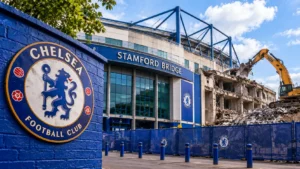
The East Stand. The club committed to a major stadium redevelopment on the strength of that success and at a cost that turned out to be far beyond what it could service.
Construction costs rose through the period, the economic conditions of the mid-seventies were severe, and the debt became unmanageable. The club was forced to sell its best players, and the side that had won two trophies was dismantled within three years.
Chelsea were relegated in 1975, and again in 1979. The stand was built and the team that justified it was gone, which is close to the purest example of a football club misjudging the durability of success.
Why does this still matter?
Because it shaped the club’s attitude to its ground for decades afterwards, and because the consequences ran into the nineties.
The financial position left the club vulnerable to exactly the kind of pressure that nearly removed it from Stamford Bridge entirely. Property interests acquired the freehold of the ground in the eighties, and the club spent years in a position where its own stadium was not securely its own.
That is the direct origin of the arrangements that still govern the ground, and it is why Chelsea’s redevelopment question is more complicated than a straightforward planning problem — the subject of why Stamford Bridge is so hard to redevelop.
Who was actually responsible?
A question that has been argued about for fifty years and does not have a clean answer, which is usually a sign that the responsibility was distributed.
The board approved a project whose costs ran well beyond the original estimate, in an inflationary period, without a mechanism to stop it. That is a governance failure and it is the proximate cause.
The construction environment of the mid-seventies made cost control extraordinarily difficult, and plenty of organisations with better finances than a football club struggled with projects begun before it and completed after. That is context rather than exculpation.
And the playing side contributed, in that a side which had just won two trophies did not sustain the league form that would have generated the revenue to service the debt. Had Chelsea challenged for titles through the mid-seventies, the stand would be remembered as ambitious rather than ruinous, and the decision would be identical. Managerial churn in the decades after is part of the same story, as set out in why Chelsea change managers so often.
The football, in more detail
The side’s identity was built on technical players in a league that mostly did not value them. Hudson and Cooke were ball-players in an era of physical midfields, and the style was closer to what would become fashionable twenty years later than to what surrounded it.
The weakness was consistency. A team capable of beating Leeds and Real Madrid finished well outside the title race in both of those seasons, and the league record across the decade is modest relative to the cup achievements.
That pattern — excellent on big occasions, unreliable week to week — recurred at the club for decades and only really changed in the late nineties. It is one of the more persistent features of Chelsea’s history.
Where the decade sits in the club’s story
Between two very different Chelseas, and that is the reason it gets discussed more than its trophy count would justify.
Before it, the club was an inconsistent London side with one league title and a reputation for being entertaining rather than serious. After it, and for roughly twenty years, the club was a second-tier concern that moved between divisions and spent most of its energy on survival.
The decade is the hinge, and the hinge turned the wrong way. That is what makes it the most examined period in the club’s history despite being neither its best nor its worst: everything that came after it was shaped by a decision taken in the middle of it.
What the decade produced
Two trophies, a generation of supporters, a stand that outlived the team that paid for it, and a financial lesson the club learned expensively.
It also produced the kit that collectors want most, which is a small consolation and a real one. Shirts from the 1970 and 1971 sides are the most sought-after in the club’s history for the straightforward reason that they are attached to its best football.
And it produced a template for how football clubs get into trouble: success, overcommitment, forced sales, decline. The sequence has repeated at clubs across England since, usually with the same stand-shaped cause, and Chelsea’s version is the one that happened first and most completely. The kits from across the period are covered in retro Chelsea shirts.
Frequently asked questions
What did Chelsea win in the 1970s?
The FA Cup in 1970, beating Leeds 2-1 in a replay at Old Trafford, and the European Cup Winners’ Cup in 1971, beating Real Madrid 2-1 in a replay in Athens.
Why were Chelsea relegated in 1975?
The cost of the East Stand redevelopment left the club unable to service its debt, forcing the sale of its best players. The side was dismantled within three years of winning two trophies.
Who were the key players in that side?
Peter Osgood, Alan Hudson, Charlie Cooke and goalkeeper Peter Bonetti, among others. Osgood scored in every round of the 1970 FA Cup.
How did this affect the club long term?
It left Chelsea financially exposed, which led to the freehold of the ground passing into property interests and shaped the club’s relationship with Stamford Bridge for decades.