
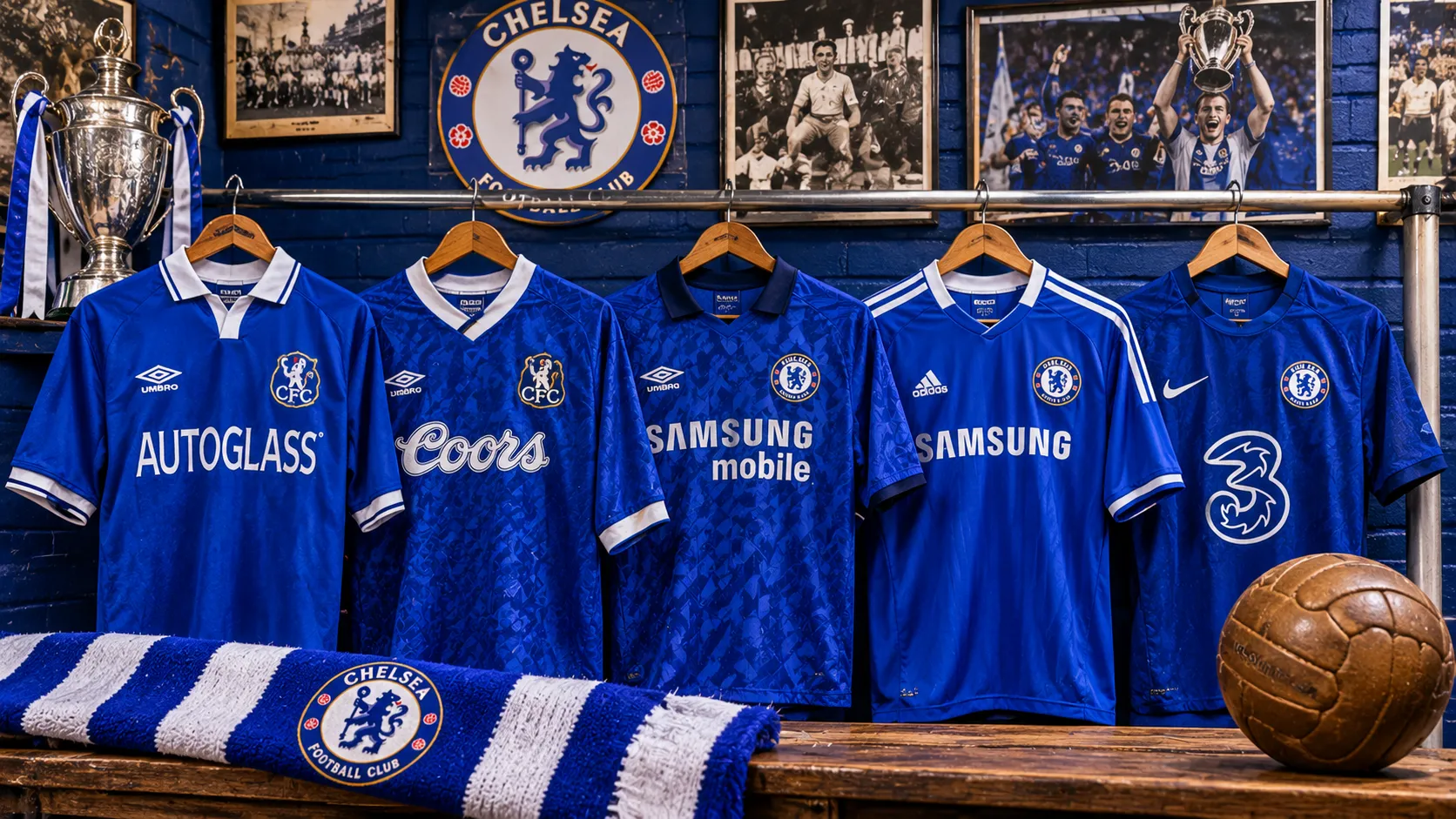
Collectors of retro chelsea shirts are buying periods rather than designs, and the periods are unusually distinct. Chelsea’s history divides into clearly separated eras with very little continuity between them, and the shirts mark the divisions better than the trophy list does.
Four of those eras matter for anyone looking at older kit: the fifties title side, the seventies cup team, the nineties revival, and the modern period. Each has a shirt attached to it and each sits in a different part of the market.
The fifties
Chelsea’s first league title came in 1954-55 under Ted Drake, nearly fifty years after the club was founded, and the kit from that period is about as plain as English football gets.
Royal blue shirt, white shorts, minimal crest, no sponsor and no supplier branding. The club’s badge was redesigned during Drake’s tenure, replacing the earlier Chelsea pensioner device, which gives a reasonably precise dating marker for anything from that decade.
Genuine shirts from this period essentially do not circulate. What you can buy are reproductions, and the good ones are heavy cotton with a correctly proportioned crest. The National Football Museum holds material from the era, and the plainness of the kit is the point rather than a limitation.
The seventies
The most collectable Chelsea period and the one with the most interesting kit. This is the side that won the FA Cup in 1970, beating Leeds in a replay at Old Trafford after a drawn final at Wembley, and the European Cup Winners’ Cup the following year against Real Madrid, also in a replay.
The shirts from that period are the ones with genuine following. Blue with white detailing, period collars, and the kind of cut that makes a reproduction either convincing or obviously wrong with nothing in between.
What makes the era resonate is what followed it. The rebuilding of the East Stand in the mid-seventies came close to ruining the club financially, and a side that had just won two trophies was relegated in 1975. The kit belongs to a high point that turned out to be the start of a long decline.
The nineties
The revival era, and the one most supporters under forty actually remember. The 1997 FA Cup win marked the point at which Chelsea stopped being an inconsistent cup side and started becoming something else.
Kits from this period are busier the nineties applied to Chelsea much as it applied to everyone, with patterned fabrics, large sponsor blocks and change strips that have aged into curiosities. Several are genuinely strange and all of them are cheap.
This is the sweet spot for a buyer. Production volumes were high enough that period shirts still turn up in wearable condition, the designs are distinctive, and prices are a fraction of what the seventies kit commands.
Which era should you buy?
Depends entirely on budget and intent. For a wearable shirt with character and no serious outlay, the nineties, and specifically a change kit rather than a home shirt.
For something that marks the club’s most significant football, the seventies, accepting that a genuine period shirt in good condition is expensive and that most of what is sold as one is a reproduction.
For a single plain classic, the fifties reproduction, which is the best-looking thing the club has worn and costs very little because almost nobody is competing for it.
What should you check on an older shirt?
Crest first, because Chelsea’s badge has been through several complete redesigns and the current version has been in use since 2005. A shirt with the modern crest cannot be from an earlier era, however convincing the rest of it looks.
Sponsor second, which narrows a shirt quickly from the mid-eighties onwards. Supplier third. And fabric weight last, which is what separates a careful reproduction from a cheap one and the thing you cannot assess from a photograph.
Shade of blue is the Chelsea-specific check and it is worth doing. The club’s blue has shifted over its history, and reproductions frequently use a modern royal blue on a shirt from a period when the tone was different, as discussed in how Chelsea blue changed.
The modern period
Worth covering briefly because it is where most shirts in circulation come from and where the least collecting interest sits. Chelsea’s successful modern era produced a long run of kits, all made in very large numbers, all still widely available.
The consequence is that almost nothing from the last twenty years is scarce, and almost nothing from it has appreciated. A shirt from a title-winning or European-winning season costs roughly what a shirt from a mid-table season costs, because supply overwhelms the difference in significance.
The exceptions are shirts tied to a single match a final kit worn once, or a one-off commemorative design and shirts with correct printing for a player whose spell at the club was short. Both are scarcity plays rather than significance plays.
For anyone buying to wear rather than to keep, the modern period is obviously the right place to look. For anyone buying with half an eye on value, it is the wrong one, and will stay wrong for another decade at least.
Where to buy and what to pay
Reproductions of the famous kits are widely available and mostly honest, because Chelsea’s history is well documented and the designs are simple enough that a decent attempt gets close.
Genuine period shirts from the nineties onwards turn up regularly through the usual channels, and condition is the whole of the price. A shirt with intact printing, a sound crest and no fabric thinning is worth considerably more than one that merely looks right in a listing photograph.
The seventies market is the one to be careful in. Demand is high, supply is minimal, and the proportion of misrepresented stock is correspondingly large. If a seventies Chelsea shirt is priced like a nineties one, it is a reproduction, and the honest sellers say so. Why that decade matters so much to the club is set out in Chelsea in the 1970s. The matchday context for all of it is covered in the Stamford Bridge matchday guide.
A note on reissues
Official reissues of the famous kits appear periodically and they solve the main problem with older Chelsea shirts, which is that the ones worth owning are either unavailable or unaffordable.
What you get is the design with modern construction: a fabric that behaves, a cut that fits a modern body, and a crest applied to a current standard. What you lose is the weight and drape that made the original what it was, and any history at all.
The ones worth paying attention to are anniversary releases tied to a specific season, which are produced in limited quantities and tend to hold their price. General reproductions of a famous design do not, and should be bought on the basis that you will wear them rather than keep them boxed.
Frequently asked questions
When did Chelsea win their first league title?
1954-55, under Ted Drake, nearly fifty years after the club was founded.
Which Chelsea era is most collectable?
The seventies, for the 1970 FA Cup and 1971 Cup Winners’ Cup side. Genuine shirts from that period are scarce and expensive.
What is the best value Chelsea retro shirt?
A nineties change kit. High production volumes mean period shirts still circulate, the designs are distinctive, and prices are low.
How do I date a Chelsea shirt?
Crest first the current version dates from 2005 and earlier designs are clearly different then sponsor, then supplier, then fabric weight.



One Response