
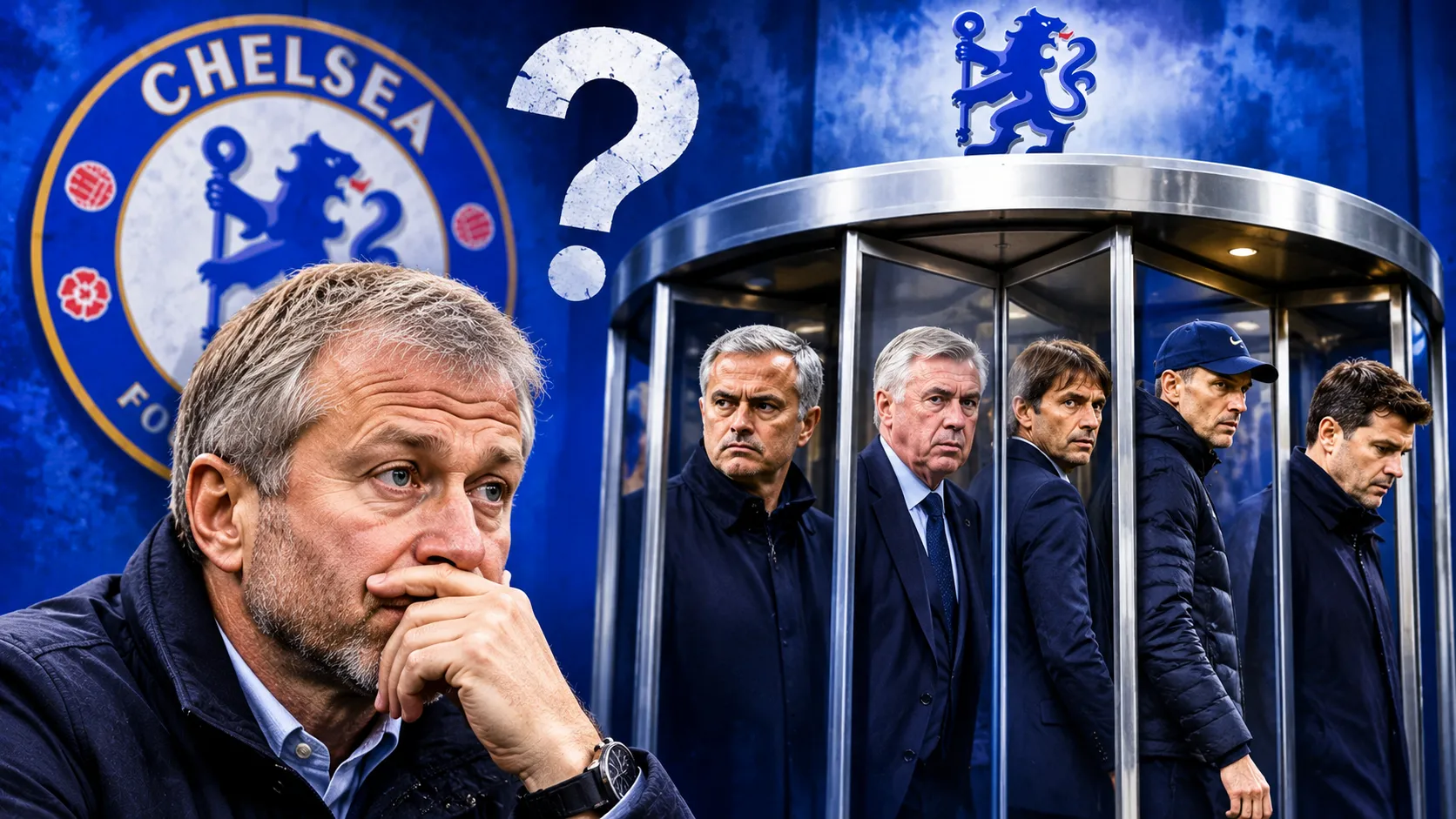
Asking why Chelsea change managers so often is the easy half. The harder and more interesting question is why, for nearly two decades, it kept working because a club that got through managers at that rate should by every conventional measure have been a mess, and instead it won five league titles and two Champions Leagues.
The answer is that the manager mattered less at Chelsea than at almost any comparable club, and that was deliberate.
The scale of it
From 2003 onwards the turnover was extraordinary by any standard. Permanent appointments, caretakers, returns of former managers, and spells measured in months rather than seasons. In several years the club began and ended the campaign under different people.
Trophies arrived throughout. Mourinho won back-to-back league titles in his first two seasons and a third in a later spell. Ancelotti won a league and FA Cup double. Conte won a title in his first season. A caretaker won the Champions League. Tuchel won another within months of arriving.
That is the pattern that needs explaining: not the sackings, but the fact that the sackings did not produce the decline they should have.
What absorbed the churn
A strong administrative core and a settled group of senior players. Through the 2000s and 2010s Chelsea kept the same handful of leaders in the dressing room for a decade or more a captain, a goalkeeper, two or three others and those players provided the continuity a manager normally provides.
Recruitment also sat largely outside the manager’s control, run centrally and continuously. That is the continental model, and it means a new coach inherits a squad built to a club profile rather than a predecessor’s personal preferences. He does not need to rebuild, so he can produce results quickly.
The practical result was that a new manager at Chelsea arrived to a functioning side, a known style and a dressing room that had seen managers come and go. Which is also why the ones who tried to change everything lasted least.
Why sack a manager who is winning?
Because the club’s tolerance for a bad run was close to zero, and because the structure made the manager replaceable. If a new appointment can produce results within weeks which at Chelsea it repeatedly did then the cost of a change is low and the threshold for making one drops accordingly.
There is also a less flattering explanation, which is that the relationship between an owner and a manager is personal, and at Chelsea for a long period it was unusually so. Several departures were plainly not about results.
What is notable is how rarely it backfired badly. For almost twenty years the club changed manager at a rate that would have destabilised most clubs and kept finishing in the top four. That is evidence for the structure, not for the strategy.
Worth separating the two things that get conflated here. Sacking a manager quickly is a decision about tolerance for a bad run. Appointing a lot of managers over twenty years is the cumulative result of that tolerance, not a strategy anyone set out. No club plans to have fifteen managers; it plans to act decisively each time, and this is what that looks like after two decades.
What changed after the ownership change
The churn continued and the reasons shifted. The new approach involved assembling a very young squad on unusually long contracts, which is a strategy that requires patience and patience is the one thing the club’s recent history suggests it struggles with.
A young squad also removes the thing that used to absorb the instability. The senior players who provided continuity through the 2010s are not there, which means a managerial change now lands on a dressing room with no institutional memory of the last one.
That is the genuine difference between the two eras of turnover. The first happened to a mature squad that could handle it. The second has happened to a squad that mostly cannot, and the results have reflected that.
The compensation, which supporters rarely get credit for naming, is that the churn has produced very few genuinely bad seasons. A club that acts quickly on a poor run also prevents a poor run becoming a poor year, and Chelsea’s worst finishes across that whole period are better than most comparable clubs’ worst finishes over the same span.
How does it compare to other clubs?
Unusual in degree rather than in kind. Plenty of clubs change managers frequently; what distinguished Chelsea was doing it while winning, repeatedly, over a long period.
The clubs usually held up as counter-examples the ones that kept a manager for a decade had a different model in which the manager was the institution. That produces great stability and a cliff edge when he leaves, which several of them experienced.
Neither approach is obviously correct. The Chelsea model trades continuity of personnel for continuity of structure, and for a long stretch it delivered more trophies than the alternative. The academy sat awkwardly inside that arrangement, as inside Cobham sets out.
What a new manager actually inherits
Worth setting out, because it explains why appointments here succeed or fail quickly rather than gradually. A new Chelsea manager inherits a squad he did not pick, assembled centrally to a club profile, frequently with more players than he can use and several on contracts that make them hard to move.
He also inherits a specific set of expectations: results within weeks, a top-four finish as the floor, and very little credit for a transitional season. That combination rewards a coach who can impose something quickly on existing players and punishes one who wants to rebuild.
The managers who have done well here are almost all in the first category arriving with a clear structure, applying it to the squad in front of them, and winning something inside eighteen months. The ones who struggled tended to be those who needed their own players to play their way, which at a club that recruits centrally is a slow and frequently fatal process.
What it costs
Money, mostly, and a specific kind of squad incoherence. Compensation for sacked managers and their staff runs to very large sums across twenty years, and each change brings a round of signings suited to one coach and unsuited to the next.
The deeper cost is in development. A young player needs a manager who believes in him for long enough to give him twenty games, and a club changing coach every eighteen months rarely provides that which is a large part of why the academy produced so little for so long despite producing so much.
It also wears on supporters in a way that is hard to quantify. A club that is always between projects never quite has an identity in the way a stable one does, and that is the thing the trophies did not buy. The clearest single example of the resulting incoherence is covered in the Chelsea number 9 problem.
Frequently asked questions
How many managers have Chelsea had since 2003?
A great many, counting caretakers and returning managers a rate far above any comparable club over the same period.
Why did the constant changes not stop Chelsea winning?
Because recruitment and structure sat above the manager, and a settled group of senior players supplied the continuity. A new coach inherited a functioning side rather than a rebuild.
Has it stopped working?
The conditions that made it work have changed. A very young squad on long contracts has no institutional memory to absorb a managerial change, so each one now costs more than it used to.
Is frequent change always bad?
Not inherently. It trades continuity of personnel for continuity of structure, and for two decades Chelsea collected more trophies that way than several more stable clubs did.






3 responses