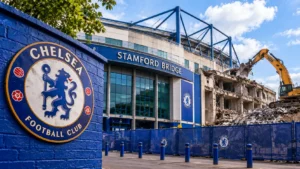

The Chelsea Tottenham rivalry explained properly has to account for something unusual: it is a derby between clubs eight miles apart that only became genuinely venomous in the last forty years. For much of the twentieth century these were two London clubs with no particular history between them, and the heat arrived late.
What produced it was a specific sequence of matches, one extraordinary statistical run, and the fact that both sides spent the 2010s competing for the same places.
When did the fixture start to matter?
The 1967 FA Cup final was the first all-London final in the competition’s history, and Tottenham won it. That gave the fixture a reference point it had previously lacked, and for a generation of supporters on both sides it was the thing the rivalry was about.
What followed was less equal. Chelsea were relegated in the mid-seventies and spent much of the next fifteen years in the second division or struggling in the first, while Tottenham won FA Cups and a UEFA Cup. Through that period the fixture was not a rivalry between equals, and Spurs supporters would reasonably have named other clubs as their main opponents.
The modern animosity is a product of what happened after 1990, which is when the balance of the fixture produced something close to statistically absurd.
The twenty-eight year run
Between 1990 and 2018, Tottenham did not beat Chelsea at Stamford Bridge in the league. Twenty-eight years, across dozens of visits, through multiple generations of both squads.
Runs like that are rare and they do specific things to a fixture. For Chelsea supporters it became an expectation and then a taunt. For Spurs supporters it became the thing that could not be mentioned, and every visit carried the weight of the whole sequence rather than just the three points.
When it finally ended, the significance was entirely about the run rather than the match. That is how a rivalry sharpens: not through a single famous game but through an accumulated pattern that both sets of supporters are conscious of every time the fixture comes round.
There is a second statistical oddity attached to the same period. For long stretches the fixture at Tottenham’s ground ran the other way, with Chelsea finding it considerably harder there than at home which meant both sets of supporters had a venue they expected to win at and one they dreaded, and the aggregate stayed closer than either run suggested.
The Battle of the Bridge
May 2016, and the most ill-tempered match in the fixture’s history. Tottenham needed to win to keep a title challenge alive; Chelsea, having had a dreadful season, were in a position to end it.
It finished 2-2, after Spurs led by two goals. The game produced a record number of yellow cards for a Premier League match, several incidents that were reviewed afterwards, and a title that went elsewhere. Both clubs were charged over the conduct of their players.
For context on why it mattered so much: Chelsea had nothing to play for and played as though they had everything. That is the clearest possible statement of what a rivalry is a fixture where the table is irrelevant to the intensity.
Why did it take so long to become a proper derby?
Because derbies need proximity in the table as well as on the map. Through the eighties and much of the nineties the two clubs were not competing for the same things, and a rivalry requires that the result changes something for both sides.
That changed in the 2000s and 2010s, when both became regular contenders for European places and occasionally for titles. Once two London clubs are fighting for the same four positions every season for fifteen years, the fixture acquires consequences, and consequences produce animosity.
The geography helped once the competitive element arrived. Eight miles is close enough for the two supports to be mixed through workplaces, schools and families, which is what gives a derby its texture.
How the two fanbases actually overlap
Eight miles is the thing that makes this different from a rivalry between distant clubs. Chelsea and Tottenham draw from overlapping parts of London and the home counties, which means the two supports are mixed through workplaces, schools, pubs and families in a way that two clubs a hundred miles apart never are.
That proximity is what gives the fixture its specific character. The result is not an abstraction to be read about on Sunday morning it determines what happens in somebody’s office on Monday, and both sets of supporters know it when the fixture is still a fortnight away.
It also explains the geography of the heat. North London supporters of either club experience this differently from west London ones, and the sharpest version of the rivalry sits in the places where the two supports are most evenly mixed rather than in either club’s heartland.
The practical consequence for anyone travelling is simply that this is a fixture where colours on public transport attract attention in both directions. It is well policed and almost always fine; it is also not the trip to treat casually.
How the fixture reads now
Competitively balanced, which is new. Both clubs have had periods of turbulence in recent years managerial churn, squad rebuilds, ownership changes and the fixture has become harder to predict than at any point since the nineties.
What has not changed is the atmosphere. This remains among the most hostile fixtures in London, and for away supporters at either ground it is the one with the sharpest edge. The policing and segregation reflect that.
For a visiting Spurs supporter the practical notes are the same as for anyone else at the Bridge, covered in our Stamford Bridge matchday guide with the single addition that this is not a fixture to wear colours on the walk up Fulham Road.
The policing arrangements reflect all of this and have done for decades. Segregated travel for parts of the away support, controlled arrival and departure times, and a heavier presence than an ordinary fixture draws. None of that is unusual for a London derby; it is simply more visible here than at the fixtures where the two supports do not overlap.
Where it sits against the other London rivalries
Below Arsenal–Tottenham in historical depth, which is a rivalry with over a century of continuous heat behind it, and above most of the rest in current intensity.
Chelsea’s own rivalry with Arsenal is older and in some ways deeper, and supporters of both clubs would argue about which of the two London fixtures matters more. The honest answer is that it depends on the decade you started watching, which is true of most derbies.
What distinguishes the Tottenham fixture is how recently it became what it is. Most great rivalries are inherited; this one was largely built within living memory, which makes it an unusually clear case study in how these things form. The European side of the club’s story is its own puzzle, covered in Chelsea’s European record.
Frequently asked questions
When did Chelsea and Tottenham first meet in a major final?
The 1967 FA Cup final, the first all-London final in the competition’s history, which Tottenham won.
How long did Tottenham go without winning at Stamford Bridge?
Twenty-eight years in the league, from 1990 until 2018 a run long enough that it became the defining fact of the fixture for both sets of supporters.
What was the Battle of the Bridge?
A 2-2 draw in May 2016 in which Tottenham’s title challenge ended. It produced a record number of yellow cards for a Premier League match and charges against both clubs.
Is this Chelsea’s biggest rivalry?
Contested. The Arsenal fixture is older and some supporters rate it higher; the Tottenham one has been more intense in recent decades. Which you pick largely depends on when you started watching.