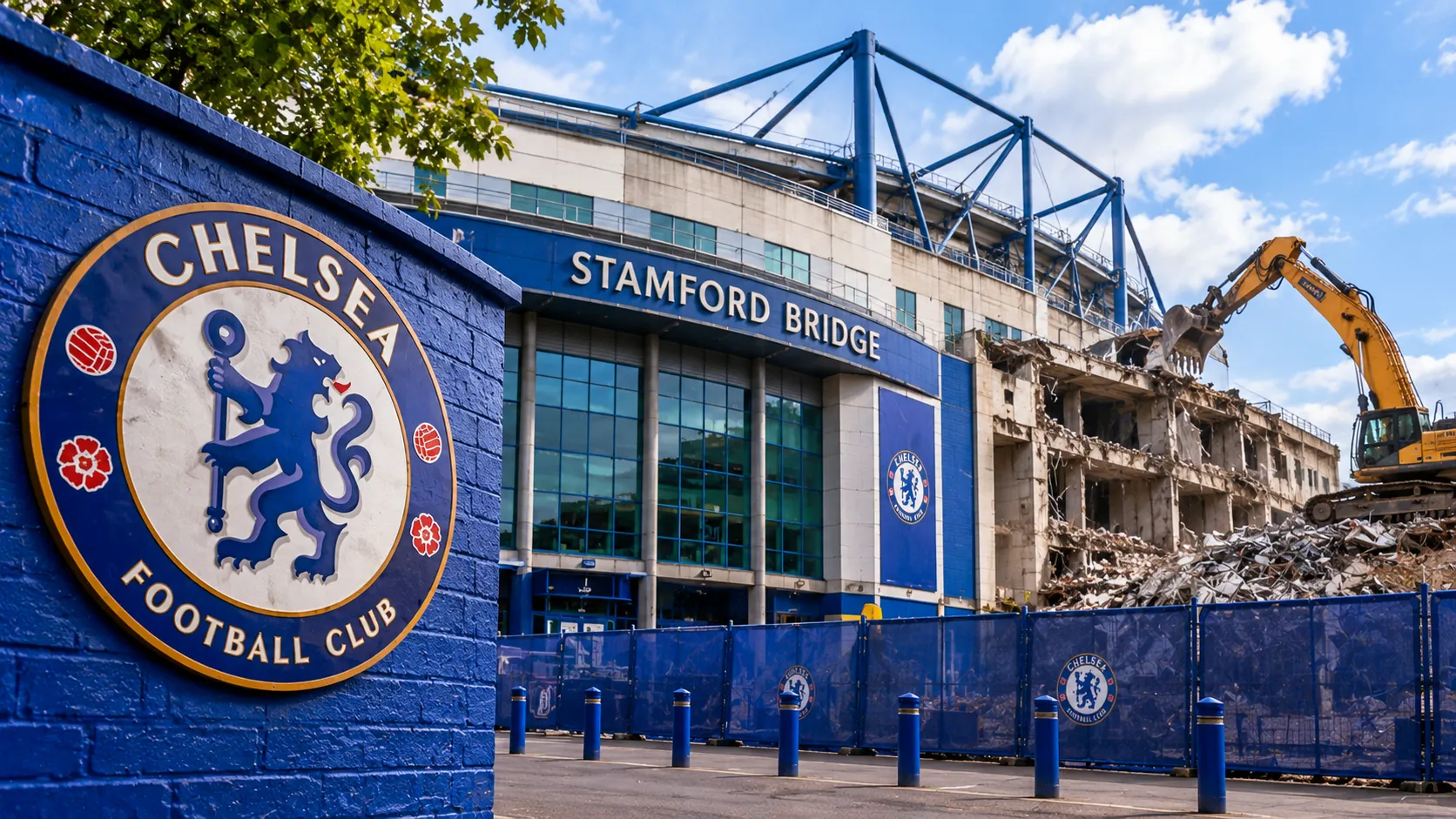
Explaining why Stamford Bridge is so hard to redevelop requires separating three constraints that get discussed as one. There is a physical problem, a planning problem, and an ownership problem, and each would be difficult on its own.
Together they explain why a club of Chelsea’s resources has one of the smaller grounds among England’s biggest sides, and why that has not changed despite repeated attempts.
The physical constraint
The site is hemmed in. A railway line runs along one side of the ground and residential streets run along the others, which leaves almost no room to expand outwards in any direction.
That is the fundamental problem and it is not solvable by spending money. A larger stadium on the same footprint has to go upwards, which raises every engineering cost and creates its own planning difficulties, or it has to acquire land that is not for sale.
It also constrains the things that make a modern stadium work. Concourse width, circulation space, hospitality areas and the exit capacity that determines the safety certificate all need floor area, and the site does not have it.
The access problem
The nearest station sits immediately beside the ground and was not built for a forty-thousand crowd, let alone a larger one. Any significant capacity increase requires a transport solution that is outside the club’s control.
This is the constraint that has defeated the most plans. Safety and transport authorities assess whether the surrounding infrastructure can disperse the crowd, and a stadium that cannot be emptied safely does not get a certificate regardless of how well it is built.
Addressing it means works to the station and the surrounding streets, which involves multiple authorities, a railway operator and the residents of a dense residential area. None of those parties has an obligation to help.
The ownership arrangement
The part that is genuinely unusual. The freehold of the pitch, and the right to the club’s name, are held by Chelsea Pitch Owners, a body set up in the nineties and owned by supporters.
The arrangement exists because of what happened in the eighties, when the ground’s freehold passed into property interests and the club came close to losing its home. The structure was created specifically to make that impossible to repeat.
The practical effect is that the club cannot move the team away from Stamford Bridge and continue to be called Chelsea Football Club without the agreement of the shareholders, who vote on it. A proposal to buy back the freehold was put to them and rejected, which demonstrated that the protection is real rather than nominal.
Is the arrangement a problem?
That depends on what you think the risk is, and both positions are held sincerely by people who support the club.
The case that it is a problem is straightforward: it constrains the club’s options in a market where stadium revenue matters enormously, and it means a decision about the club’s commercial future rests with shareholders rather than with its management.
The case that it is not is equally straightforward: it was created in response to something that actually happened, the thing it prevents is the loss of the ground, and no structure that can be set aside when it becomes inconvenient would have prevented that in the first place.
What is not arguable is that it is a deliberate constraint rather than an accident. It was designed to be hard to remove, and it has been.
What has actually been proposed?
Several schemes over the last two decades, none of which reached construction, and the reasons they stalled are instructive because they are different reasons.
An on-site rebuild of substantially greater capacity has been the recurring preference. The engineering is possible; the issue is the combination of cost, the access constraint and the need to play elsewhere for a period measured in years, with no obvious London venue of the right size available for that long.
Moving to a new site in the area has been examined repeatedly and runs into the simple fact that west London has almost no land of the required size. The sites that have been floated are either too small, already in use, or would require transport provision no less difficult than the one at Stamford Bridge.
A move further out, to a site where land and transport are both available, solves the physical problem and creates a different one. It would put the ground outside the area the club has been part of since 1905, and it is the option the pitch ownership arrangement exists to make difficult.
What the options actually are
Rebuild on site, which means a lengthy period playing elsewhere, enormous cost, and a capacity gain limited by the access constraint. This has been the preferred route in most proposals and has repeatedly stalled.
Move and keep the name, which requires the shareholders’ agreement and a site in west London that does not obviously exist.
Or stay as is, accept the capacity, and compete on other revenue streams which is effectively what has happened, and which is less of a disadvantage than it would have been twenty years ago because commercial and broadcast income have grown faster than matchday income has.
How the capacity compares
Worth stating plainly, because the figure surprises people. Stamford Bridge holds around forty thousand, which places it well below the largest grounds in the Premier League and below several clubs with a fraction of Chelsea’s revenue.
Grounds built or rebuilt in the last two decades have gone substantially larger, because the economics of matchday income reward capacity and because the sites chosen allowed for it. Chelsea’s site did not, and the gap has widened every time another club has rebuilt.
The revenue consequence is real and bounded. Matchday income is the smallest of the three major revenue streams at a club of this size, so a capacity shortfall of twenty thousand costs less than it would have done in 1995, when the gate was a far larger share of the business. It is a disadvantage rather than a crisis, and it is one that cannot be bought away.
What it does affect is the supporter base’s ability to actually attend, which is the part that matters to the people reading this rather than to an accountant. The competition for tickets is a direct consequence of the constraints above, and it is covered alongside the practicalities in the Stamford Bridge matchday guide.
What it means for supporters
A smaller ground than the club’s size suggests, which has a compensating effect that supporters are divided about. Stamford Bridge is tighter and closer to the pitch than any newly built stadium of comparable standing, and the atmosphere benefits from that.
It also means tickets are harder to get than at clubs with larger grounds, and that is a real cost rather than a romantic trade-off. Demand exceeds capacity consistently, and the gap is structural.
The honest summary is that the constraint is permanent until the access problem is solved by someone other than the club. The ground’s history is bound up with the kit history too, since the stands in the background of every famous photograph changed as often as the shirts did a sequence traced in retro Chelsea shirts.
Frequently asked questions
Why can Stamford Bridge not simply be expanded?
The site is bounded by a railway line on one side and residential streets on the others, leaving no room to expand outwards and limited floor area for the circulation space a larger stadium needs.
What is Chelsea Pitch Owners?
A supporter-owned body holding the freehold of the pitch and the rights to the club’s name, set up in the nineties after the ground’s freehold had passed into property interests.
Does the club need permission to move?
To move and retain the name, yes the shareholders of Chelsea Pitch Owners would have to agree, and a proposal to buy back the freehold was rejected.
What is the biggest single obstacle?
Transport access. The surrounding infrastructure limits how large a crowd can be dispersed safely, and solving it requires authorities and operators outside the club’s control.